What are IMD Electricity and shared electricity?
IMD Electricity (sometimes written IMD-el) stands for individual metering and billing of electricity, and in practice it is called "shared electricity with IMD". The association terminates the apartments' separate electricity subscriptions, signs a single shared grid and electricity supply contract for the whole property and fits a sub-meter in every apartment. Residents are freed from their own fixed grid charges, while every kilowatt hour is still metered and billed exactly per household.
The saving comes in two layers. The first and largest is that the individual fixed charges disappear. Instead of every apartment paying a fixed grid charge and a fixed supplier charge each month, the association pays a single shared charge for the whole building. The second layer is negotiating position: as a large customer the association can often sign a better price per kWh than individual households can reach.
This is what individual metering of electricity is about in a housing association. The collective buys electricity more cheaply as one unit, but fairness is kept, because the sub-meters mean nobody subsidises anyone else's consumption.

IMD Electricity or your own electricity subscription?
The difference from today's arrangement, where every apartment has its own electricity subscription, comes down to who buys the electricity and what the fixed charges look like.
| Comparison | Own electricity subscription | Shared electricity with IMD |
|---|---|---|
| Number of contracts | One per apartment | One for the whole property |
| Fixed charges | One set per apartment | One shared, spread across all |
| Choice of supplier | Each household chooses | The association chooses for all |
| Negotiating position | As an individual customer | As a large customer |
| Total electricity cost | Higher | Lower |
The real trade-off is choice against cost. With your own subscription every resident can pick their own electricity supplier, but pays their own fixed charge in full. With shared electricity that individual choice of supplier goes away. In return the many fixed charges disappear and the association negotiates a cheaper contract as a large customer. For most associations the lower total cost outweighs the individual choice.

How the system works
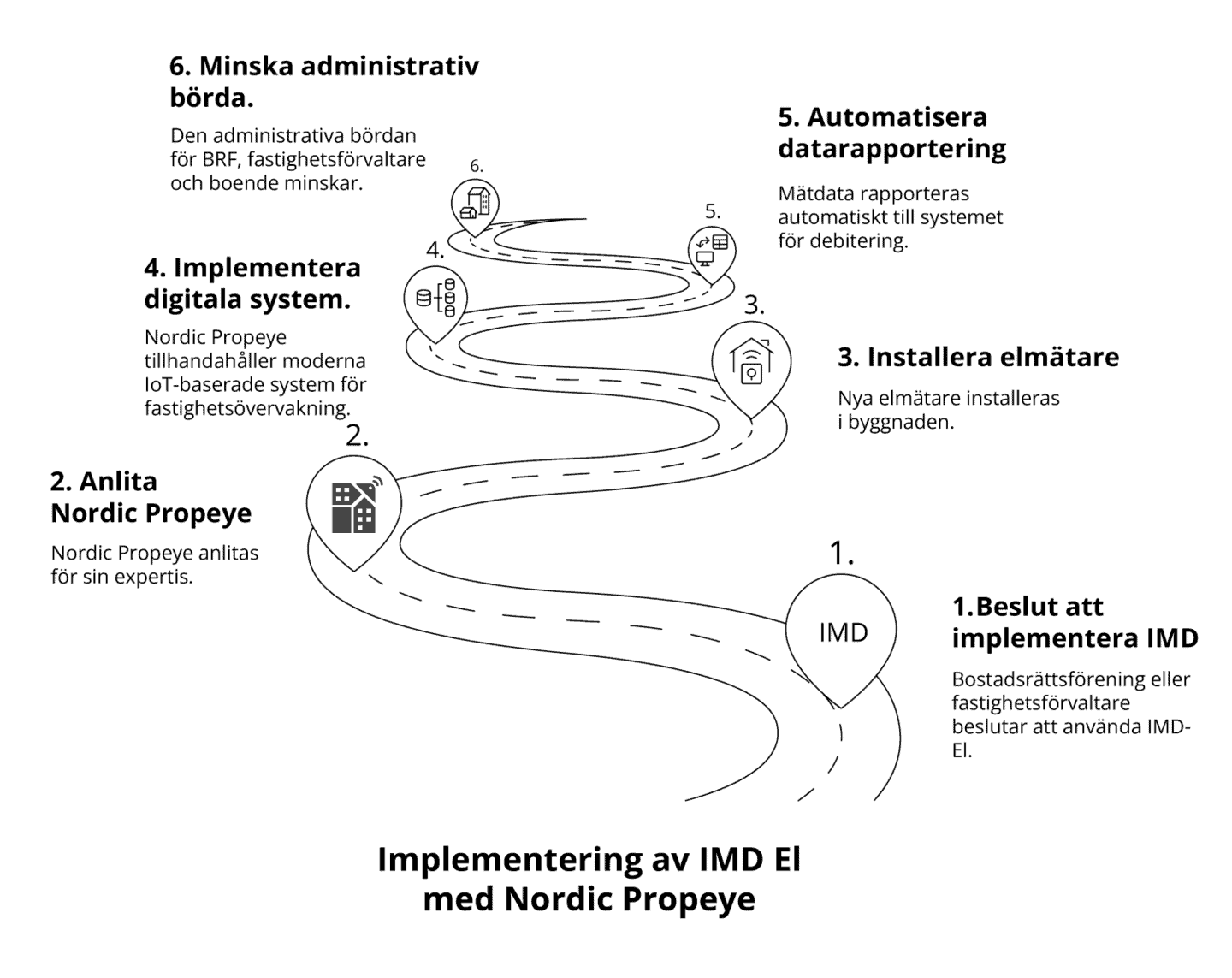
The route from decision to day-to-day operation runs in five steps.
-
Decision at the general meeting and a shared electricity contract. The association's general meeting approves the change, and the association signs a shared grid and electricity supply contract. The property's existing main meter is used by the electricity companies as the billing point.
-
Installing sub-meters. One electricity meter per apartment is installed, often gathered in a shared meter cabinet. The Metering supplier uses as much of the existing electrical installation as possible to keep the work in the building down.
-
Closing the individual subscriptions. The Metering supplier terminates each apartment's existing subscription with the grid company and the electricity supplier. Residents do not need to do anything themselves, and from the changeover the individual fixed charges disappear.
-
Collecting metering data. The sub-meters are read remotely. Data is fetched by cable via M-Bus or wirelessly via LoRaWAN to a gateway and on to a cloud service. Wireless technology helps in older buildings where new cabling is expensive to install.
-
Billing. The metered values are sent automatically to the association's financial administrator. Each resident is billed on their ordinary monthly invoice for their actual electricity use plus their share of the shared fixed charge, and at the same time can follow their own consumption in the portal or the app.

What can you save?
The association's total electricity cost typically falls by 15–25 percent. Per apartment that corresponds to roughly 1,500–3,500 kr per year net. The investment in meters and system normally has a payback of 1–2 years, and after that the saving is a running gain for the association and its members.
A worked example makes the order of magnitude clear. An association with 50 apartments where each apartment pays 1,500–3,000 kr per year in fixed charges has up to 150,000 kr a year going to grid fees and administration rather than to the electricity itself. After the changeover the association instead pays a shared fixed charge of roughly 10,000–15,000 kr per year for the whole property. The difference is spread across the members.
How much your own association saves depends on the number of apartments, today's fixed charges and what shared contract can be negotiated. Try Nordic Propeye's calculator for your own estimate.
If you want a figure anchored in your own property you can request a free quote. It is property-specific and carries no obligation.
What does it cost to introduce IMD Electricity?
The whole job, meaning meters, installation and any rebuild of the electrical service connection, costs roughly 2,000 kr per apartment. It is a one-off investment, and because the individual fixed charges disappear it normally pays for itself in 1–2 years. After that the lower electricity cost is a running gain for the association.
The exact cost is property-specific. It depends on the number of apartments, what the existing electrical installation looks like and whether the service connection needs rebuilding. We produce a firm quote free of charge before the association makes any decision.
Why now? Grid fees are rising
The electricity grid is a local monopoly. A property owner cannot switch grid company the way an electricity supply contract can be switched, so when the grid fee goes up there are few ways to influence the cost. The effective countermeasure is to reduce the number of subscriptions being billed, which is exactly what shared electricity with IMD does.
Energimarknadsinspektionen has approved increases in grid fees of roughly 44 percent over the period 2024–2027. That is a structural increase driven by investment needs in the grids, not a temporary swing in the business cycle. For 2025 the average increase is 9–14 percent in most counties according to the Nils Holgersson report.
On top of this, capacity tariffs are spreading, where the charge is based on the property's highest power draw during the month and not only on the number of kilowatt hours consumed. A short peak when several apartments use the hob, the shower and EV charging at the same time can then affect the charge for the whole building. With an IMD platform the association gets the insight into power draw needed to handle this.
We have written more about the background in Record increases in grid fees and about the regional differences in Electricity prices are swinging sharply.
Solar panels and the VAT deduction
Shared electricity makes a solar investment considerably more profitable. Without IMD the association can in practice only use self-generated electricity in the building's communal areas, such as stairwells and the laundry room. The surplus is then sold to the grid at a low price, often back to the same electricity company the association goes on to buy electricity from.

With IMD Electricity the association can instead sell the self-generated electricity internally to the members in their apartments. Because more electricity is then used internally, a larger solar installation becomes profitable, and a larger share of production is put to use.
When the association sells electricity on, it becomes liable for VAT on those electricity sales. That is normally handled entirely by the financial administrator or the Metering supplier. The VAT liability also brings the right to deduct input VAT on investments in electricity-related equipment such as solar panels and meters. For an association planning solar panels that matters financially: the payback on the installation typically shortens from about 10 years to 7–8 years.
The foundation for energy optimisation
The solar panels are one example of a larger point. Once IMD Electricity is in place the property works as a single metered electrical system, with full insight into how each apartment and the whole building uses electricity. That is the precondition for optimising energy, not just metering it. Self-generated solar electricity can be used internally, a battery can store surplus for the evening consumption peak, and EV charging can be steered to hours when the building draws little anyway.
Here IMD Electricity is a building block rather than the goal in itself. With the metering and the shared contract in place, the association can add PropSaver, which optimises the heating from measured indoor temperature and steers heating, storage, solar, battery and charging together to cut the peaks, and smart charging stations that move charging to low-load hours. That way the association lowers both energy use and capacity charges over time.
Rules and legal requirements
Unlike IMD Water, where requirements apply in new build and for major renovations, IMD Electricity is entirely voluntary in Sweden. There is no statutory obligation to introduce individual metering of electricity.
Being voluntary means the decision sits with the association. In a housing association a decision at a general meeting is normally required, at the ordinary meeting or an extraordinary one, and the association's statutes should permit individual billing of electricity. When the association starts selling electricity on to its members, VAT liability arises on those electricity sales, but the administrative side is in practice handled by the property manager or the supplier.
In rental properties where electricity is included in the rent today, it is reasonable to inform tenants well in advance and to lower the base rent correspondingly when the electricity cost starts being billed separately, so that nobody pays twice.
Is IMD Electricity right for your association?
The value is greatest for housing associations with many apartments. The removal of the fixed charges scales with the number of subscriptions eliminated, so the more apartments, the larger the combined saving. It also suits associations that are considering solar panels or already have them, and associations that want to future-proof against capacity tariffs.
The solution also works for private property owners with rental properties where electricity is included in the rent, or where the landlord wants to steer electricity use for other reasons. In that case the base rent should be adjusted downwards when the electricity starts being billed per apartment.
If you want to see what the changeover would give in your own property, we produce a full analysis of the saving and the roll-out. Read more about our IMD Electricity solution or fill in the form further down, and we will come back to you at no cost and with no obligation.
Frequently asked questions
What is the difference from each apartment having its own electricity subscription?
With shared electricity the association signs a single grid and electricity supply contract for the whole property instead of every apartment having its own. The individual fixed charges disappear, but each household still pays for its own consumption thanks to a sub-meter in every apartment.
Can residents still choose their own electricity company?
No. The association's shared contract covers every apartment, so individual residents cannot pick their own electricity supplier. In return the total electricity cost is lower, and as a large customer the association can sign better contracts than individual households can reach.
How much does one apartment save?
Typically 1,500–3,500 kr per apartment per year net, which corresponds to the association's total electricity cost falling by roughly 15–25 percent. The actual figure depends on the number of apartments, today's fixed charges and what shared contract can be negotiated.
Does IMD Electricity work with solar panels?
Yes, and it makes the solar investment more profitable. With shared electricity the association can sell self-generated electricity internally to the members instead of exporting it cheaply to the grid. The VAT liability on the electricity sales also brings the right to a VAT deduction, which typically shortens the payback on the solar installation from about 10 years to 7–8 years.
Is IMD Electricity a legal requirement?
No. Unlike IMD Water, IMD Electricity is entirely voluntary in Sweden. The decision sits with the association and normally requires a decision at a general meeting.
Are there any drawbacks to IMD Electricity?
The main drawback is that residents can no longer sign their own electricity contract, because the association's shared contract covers everyone. The changeover also requires a decision at a general meeting and an investment in meters. Against that, the fixed charges disappear and the electricity cost falls, and the investment normally pays for itself in 1–2 years.
How long is the payback?
Normally 1–2 years for the investment in meters and system. After that the saving is a running gain for the association and its members. Roughly speaking, the contracting cost is around 2,000 kr per apartment.